Ten In, Ten Out: Every Change to the ImageForge Model Lineup
Update, 8 October 2026: every model is now on every plan, including Free. Models are priced in credits only, so the Free-plan labels below describe the lineup as it was when this post was published.
We recently reviewed every model in the ImageForge lineup against what is actually available, and what is actually worth its price, today. The result is the largest change to our lineup since launch: 10 models out, 10 models in, 6 kept. The headline numbers did not move — still 16 models, still 4 of them on the Free plan — but nearly two-thirds of the roster is new.
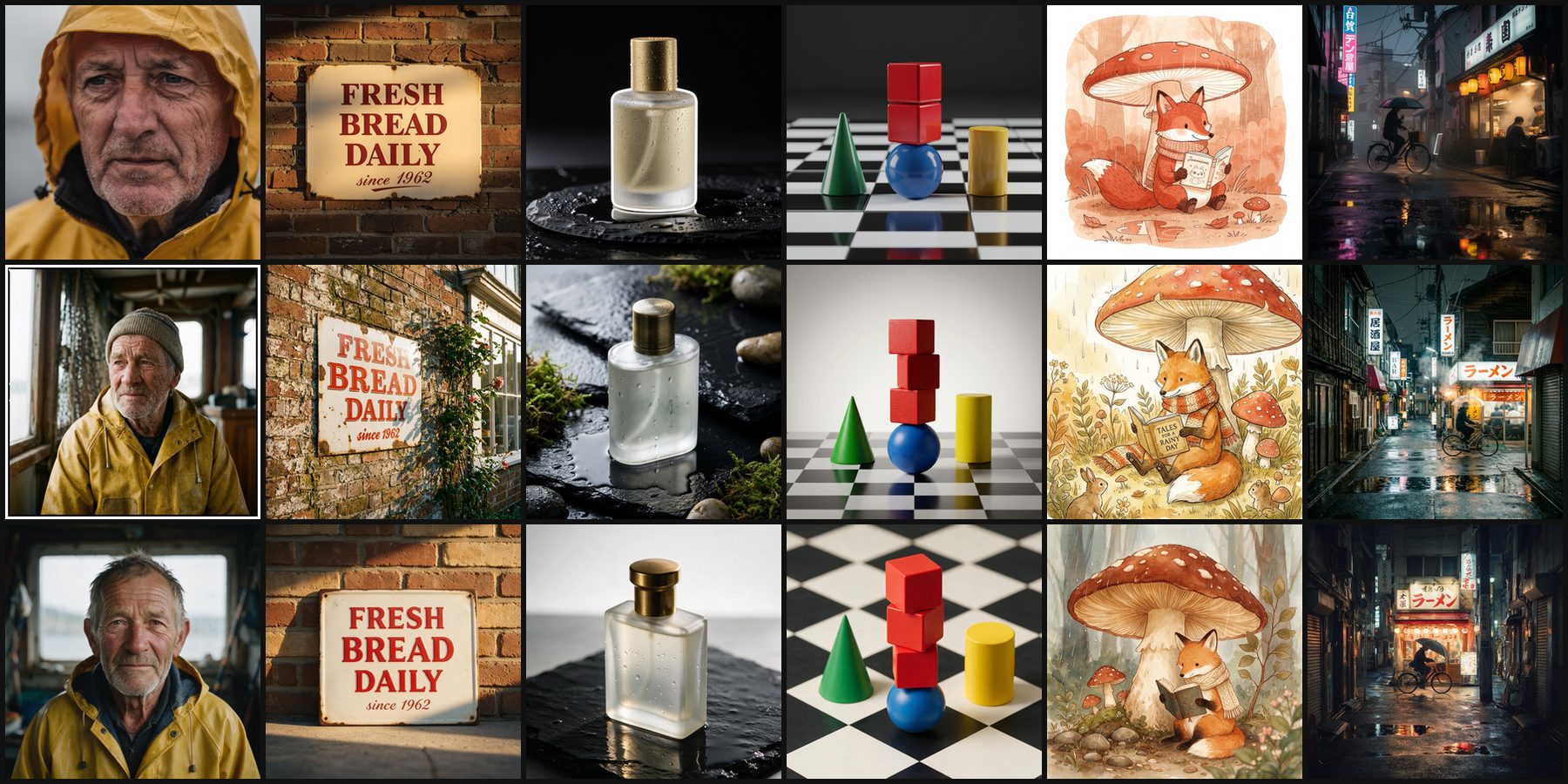
This is the full accounting. What arrived, what left, what each new model is actually for, and where it sits relative to what it replaced. None of these is "the best model." They have different jobs, and the interesting part is which job each one took over.
Why a lineup changes at all
Three different forces drove this, and it is worth separating them, because they justify very different decisions.
1. Models get withdrawn. The Imagen 4 family — standard, Fast and Ultra — became unavailable to us on 30 June 2026 and stopped returning images altogether. Imagen 4 Fast was a Free-plan model and the first entry in the Quick category, which made it the default for anyone who never opened the model picker. This was not a taste decision. The model stopped working and we were still offering it.
2. Families ship new generations. Ideogram V3 to V4, Recraft V3 to V4, Kling Image V3 to O3, Grok Imagine to 2.0, Seedream 4.5 to 5. When a vendor ships a successor, keeping the predecessor is an active decision to serve older output at the same price.
3. Unit economics. Seedream 4.5 sat on the Free plan at our cheapest rate while costing us more per image than that rate brought in. A model in that position is not sustainable, and pretending otherwise just means it disappears later without warning.
The lineup now
Costs below are at Standard quality (1 megapixel). Credit cost scales with resolution — 2MP doubles it, 4MP quadruples it — and the Free plan is limited to 1MP.
| Model | Provider | Credits (1MP) | Plan | Refine? | Best for |
|---|---|---|---|---|---|
| FLUX.2 [klein] 9B | Black Forest Labs | 1 | Free | Yes | Fast iteration |
| Z-Image Turbo | Alibaba | 1 | Free | No | Raw speed, prompt adherence |
| FLUX.2 [dev] | Black Forest Labs | 1 | Free | Yes | Everyday workhorse, text |
| Ideogram V4 | Ideogram | 1 | Free | No | Typography, logos |
| Seedream 5 Lite | ByteDance | 2 | Paid | Yes | Versatile styles, multi-image edits |
| FLUX.2 [flex] | Black Forest Labs | 2 | Paid | Yes | Adjustable quality/speed |
| FLUX.2 [pro] | Black Forest Labs | 2 | Paid | Yes | Production-grade realism |
| Seedream 5 Pro | ByteDance | 2 | Paid | Yes | ByteDance flagship, up to 4MP |
| Recraft V4 | Recraft | 2 | Paid | No | Style control, clean composition |
| Kling Image O3 | Kuaishou | 2 | Paid | Yes | Photorealism, prompt adherence |
| Grok Imagine 2.0 | xAI | 2 | Paid | Yes | Aesthetic, high-impact imagery |
| FLUX.2 [max] | Black Forest Labs | 3 | Paid | Yes | Highest-fidelity FLUX |
| Nano Banana 2 | 3 | Paid | Yes | Text and composition, fast | |
| Hunyuan Image 3.0 | Tencent | 3 | Paid | Yes | Reasoning, multi-concept scenes |
| Nano Banana Pro | 5 | Paid | Yes | Maximum complexity, character consistency |
A sixteenth model, FLUX Kontext [pro], is edit-only: it does not appear in the generation picker, only when you refine an existing image.
The ten new models, one at a time
FLUX.2 [klein] 9B — 1 credit, Free plan
Replaces: FLUX.1 [schnell]
The free speed slot moves up a full generation. FLUX.1 [schnell] was a FLUX.1-era distillation; klein is a 9B distillation of FLUX.2, so the cheapest model in the lineup now inherits FLUX.2's prompt handling and text rendering rather than the previous generation's.
The change we care about most is not quality, though. FLUX.1 [schnell] could not accept an input image, so it could not be refined. Neither could Imagen 4 Fast. That meant the entire Quick category was a dead end: generate, and if it was close but wrong, start over. klein supports editing with up to four reference images, so a fast first pass can now be iterated on instead of thrown away.
Reach for it when: you are still deciding what you want. It is the cheapest way to see ten variations of an idea.
Z-Image Turbo — 1 credit, Free plan
Replaces: Imagen 4 Fast (as the second Quick-category slot)
Alibaba's first appearance in our lineup, and the ninth provider overall. It is positioned on raw speed with strong prompt adherence — closer to "do exactly what I said, immediately" than to "interpret me generously."
The honest trade-off: like Imagen 4 Fast before it, Z-Image Turbo takes no input image, so there is no refinement path. It is a one-shot model. Pair it with klein and you have the two halves of the Quick category covered — one you can iterate on, one that is purely fast.
Reach for it when: your prompt is already precise and you want the result now.
Ideogram V4 — 1 credit, Free plan
Replaces: Ideogram V3 (which was 2 credits, paid only)
This is the single biggest accessibility change in the update. Ideogram built its reputation on text rendering, and V3 was a premium model at double the price. V4 is both newer and on the Free plan, at the cheapest rate we charge.
If you generate anything with words in it — posters, social graphics, product mockups, logo concepts — this is the model that moved into your reach. It also carries a reasoning capability alongside typography, which matters for prompts where the text has to make sense in context rather than just be legible.
It does not accept an input image, so like V3 it is generate-only. That is the one thing it gave up nothing on, because V3 could not refine either.
Reach for it when: legible, well-placed text is the point of the image.
Seedream 5 Lite — 2 credits, paid
Replaces: Seedream 4.5 (which was 1 credit, Free plan)
We should be straightforward about this one: it is a step down in accessibility. Seedream 4.5 was free and Seedream 5 Lite is not. The reason is the unit economics above — 4.5 cost us more per image than a single credit was worth, and Ideogram V4 took the Free-plan slot it vacated.
What you get for the second credit is a genuinely more capable model. Seedream 5 Lite supports multi-reference editing with up to ten source images and multi-turn refinement, which is the deepest editing capability at the 2-credit tier. If you composite — putting a product into a scene, keeping a character consistent across a set — this is the cheapest model that does it properly.
Reach for it when: you are combining several images, not generating one from nothing.
Seedream 5 Pro — 2 credits, paid
New capability tier for the family
ByteDance's flagship, at the same 2 credits as Lite. That pricing looks odd until you read it as what it is: Lite is the fast variant, Pro is the quality variant, and we are not charging a premium for the choice. Pro carries both versatility and realism, handles up to 4MP, and shares the same ten-image editing pipeline as Lite.
Because they cost the same, the decision between them is purely about speed versus fidelity — which is exactly the kind of comparison ImageForge exists to let you run side by side.
Reach for it when: you liked what Lite did and want the finished version of it.
Recraft V4 — 2 credits, paid
Replaces: Recraft V3
Recraft has always been the precision option: style control, accurate text, clean composition, the qualities that matter for brand and vector work rather than photography. V4 continues that at the same 2 credits V3 cost.
One regression worth naming, because we would rather you hear it from us: Recraft V3 accepted an input image, so you could refine with it. V4, as it is available today, does not. If refinement on Recraft was part of your workflow, that path is gone for now, and FLUX Kontext [pro] or Seedream 5 is the closest substitute.
Reach for it when: you need tight stylistic control and the output is final on the first pass.
Kling Image O3 — 2 credits, paid
Replaces: Kling Image V3
Kuaishou's successor, same price, positioned on photorealism with strong prompt adherence. The more meaningful change is that refinement on Kling actually works now — see the fixes section below, because Kling V3's refinement was broken in a way that is worth explaining.
Reach for it when: you want a photorealistic read and you want the model to follow the prompt literally.
Grok Imagine 2.0 — 2 credits, paid
Replaces: Grok Imagine
xAI's second generation, same price as the first. Grok's distinguishing trait in our lineup has always been aesthetic rather than technical — it produces images with a point of view, which is useful when visual impact matters more than accuracy.
2.0 pairs style transfer with colour accuracy on the editing side, a slightly unusual combination: most editing models optimise for preserving the subject, this one for preserving the palette while changing the treatment.
Reach for it when: the image needs to stop someone scrolling.
FLUX.2 [max] — 3 credits, paid
Replaces: FLUX.1.1 [pro], and raises the family ceiling
FLUX.2 now runs klein, dev, flex, pro and max — five rungs from 1 credit to 3, all in one family with consistent prompt behaviour. That consistency is the underrated part: you can prototype on klein for 1 credit and finish on max for 3 without the model reinterpreting your prompt on the way up.
max is the only model in the lineup carrying both realism and typography, and it supports multi-reference editing. It is the model to use when the work is going in front of a client.
FLUX.1.1 [pro], which it displaces, was a FLUX.1-generation model at 2 credits with no refinement support at all.
Reach for it when: this is the final asset and it has to hold up at full size.
Nano Banana 2 — 3 credits, paid
Replaces: the Imagen 4 family, in practice
Losing all three Imagen 4 models could have meant losing Google from the lineup. It did not — Google just moved products. Nano Banana 2 arrives at 3 credits with reasoning and typography, fast multi-turn editing, and support for up to ten source images.
It also fills a real gap in the price ladder. Nano Banana Pro is our most expensive model at 5 credits per megapixel, which is a lot to spend to find out whether Google's approach suits your prompt. Nano Banana 2 lets you answer that question for 3.
Reach for it when: you want Google's compositional style without committing to Pro's price.
What we retired, and why
Gone because the model was withdrawn: Imagen 4 Fast, Imagen 4 and Imagen 4 Ultra, all three unavailable since 30 June 2026. There was no alternative here.
Gone because a successor shipped: FLUX.1 [schnell], FLUX.1.1 [pro], Ideogram V3, Recraft V3, Grok Imagine, Kling Image V3. In every case the replacement is the same vendor's newer model, at the same price or cheaper.
Gone for cost reasons: Seedream 4.5, discussed above.
What stayed, and why
Six models survived the audit unchanged, and the reason in each case is that nothing better exists at their price point yet:
- FLUX.2 [dev] — still the best value in the lineup. Free plan, 1 credit, refinement included.
- FLUX.2 [flex] — the only model that lets you trade quality against speed directly.
- FLUX.2 [pro] — the production default, now with max above it rather than at the top.
- Hunyuan Image 3.0 — Tencent's reasoning model, still distinctive for multi-concept scenes.
- Nano Banana Pro — the ceiling for compositional complexity and character consistency.
- FLUX Kontext [pro] — edit-only, and still the specialist for targeted edits.
Two fixes that shipped with the update
The audit turned up two live defects, and both are fixed.
Imagen 4 Fast was failing for everyone who used it. It was a Free-plan model sitting first in the Quick category, pointing at a model that had stopped responding back in June. If you tried ImageForge, accepted the default and got an error, that was this. We are sorry — this should have been caught far sooner than it was.
Refinement was broken on two models. Kling Image V3 and Hunyuan Image 3.0 handle editing separately from generation. When you asked either of them to refine an image, our pipeline was sending a plain generation request instead — one that carried no source image — so there was nothing to edit and the request was rejected. The fix makes that combination structurally impossible, and a regression test now walks every model that edits separately and asserts the source image is there.
Your generation history still reads correctly
Retiring ten models raised an obvious problem: everything you generated with them is still in your gallery. Retired models keep their display names, so an image you made with Imagen 4 Ultra in March still says "Imagen 4 Ultra" rather than falling back to a raw internal slug. You cannot generate with them any more — attempting it gives you an explicit message saying the model was retired — but your history stays readable.
How to choose now
The short version, if you do not want to read the table again:
- Exploring an idea: FLUX.2 [klein] 9B. One credit, fast, and you can refine what it gives you.
- Anything with text in it: Ideogram V4 first, FLUX.2 [dev] second. Both are 1 credit on the Free plan.
- Compositing or editing: Seedream 5 Lite or Nano Banana 2 — both take up to ten source images.
- Final client work: FLUX.2 [max] or Nano Banana Pro, depending on whether you want fidelity or compositional complexity.
- Genuinely unsure: run three of them on the same prompt. That is the whole reason this platform exists.
Every claim in this post about what a model is good at is a starting point, not a verdict. Model strengths are prompt-dependent in ways no comparison table captures, and the model that wins on your prompt may not be the one that wins on ours. On a Basic or Pro plan you can send one prompt to up to five models at once and settle it for your own work in a single generation.
Open the studio and try the new lineup, or compare plans if you need multi-model generation.